Storyyour input · ~777 words
The Joke Painted Large Enough to Stop Traffic
THE GIRL ON THE HOARDING — THE AMRIT STORY

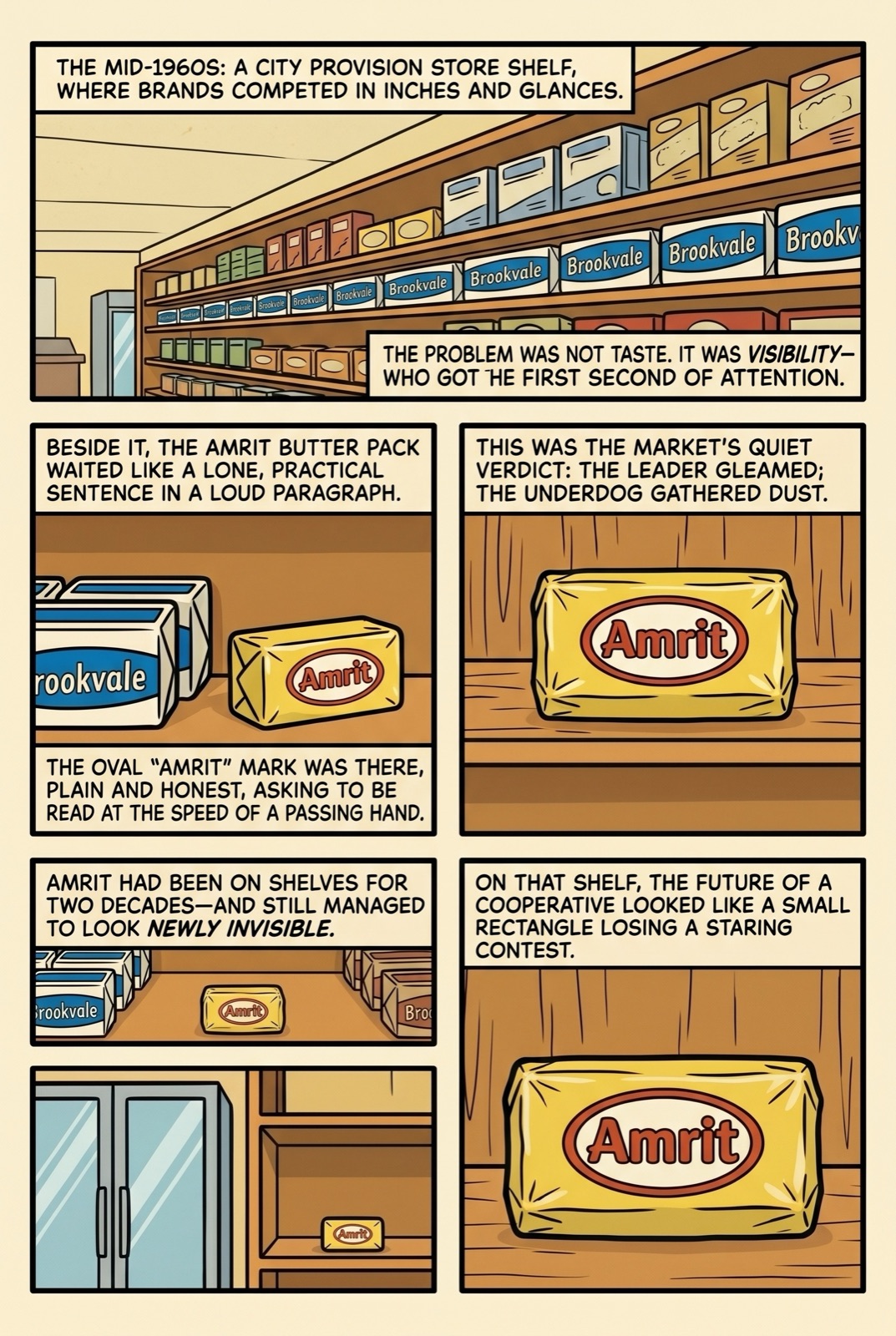
On the shelves of a city provision store, two packs of butter sit side by side. One is Brookvale — the big name, the brand everyone reaches for. Beside it, almost overlooked, sits Amrit. The cooperative's butter had been on shelves for two decades by then, but Brookvale was the bigger player, and on this shelf you could see exactly who was winning.

This is where the story begins — not with the giant, but with the brand that wasn't.

That year, Sebastian Mehra, managing director of the advertising agency Crest — Creative Retail & Sales Trade — won the Amrit butter account. A small cooperative brand handed to an adman who would have to find a way to make people notice it.

There was one big constraint. Most of the advertising would live outdoors, on hoardings, painted by hand — a requirement attributed to Harold Velan, the chairman of the federation, the man who had built the milk cooperative behind Amrit. Whatever the campaign became, an ordinary signboard painter had to be able to reproduce it, again and again, across the country.

So Mehra and Crest's art director, Aloysius Faria, sat down and drew a girl.

Not a model. Not a celebrity. A cartoon — a small moppet in a polka-dotted frock, with blue hair and a half-pony tail, big-eyed and impossible to forget. She was built deliberately: simple enough to be hand-painted on a hoarding, memorable enough to stick. And she was a direct counter to Brookvale, which had its own butter-girl mascot. Amrit's answer to Brookvale's girl was a better girl.

On the board she was just lines and a tin of butter. Nobody in that room knew they had just drawn the face the country would argue with for the next half-century.

That autumn, the first hoardings appeared — on lamp kiosks and bus sites across the city. There she was, the moppet, sitting on a horse, with the baseline beneath her:

"Thoroughbread, Simply Spreadly Delicious Amrit."

The pun — "Simply Spreadly" — is credited to Sebastian's wife, Nita Mehra. A throwaway line that would outlast almost everyone who first read it.

Here is where the campaign turned into something nobody else was doing.

Instead of just selling butter, Amrit made the girl a commentator. The hoardings went topical — current events, politics, films, scandals, sport — each one a fresh joke in fresh paint, riffing on whatever the country was talking about that week. Within a few years she was playing on the season's biggest film craze. The Amrit Girl had become a social observer, and the country had pioneered, on its own street corners, what the trade would later call real-time "moment marketing."

People stopped seeing an advertisement. They started checking what she'd say next.

A commentator who never stops eventually says something someone in power doesn't like.

The Amrit Girl took on events of national and political importance — including, in those years, commentary during a tense stretch when civil liberties were suspended. And on another occasion, one hoarding showed her in a freedom-march cap, the cap a symbol of the independence movement. It drew official ire, and the hoarding was reportedly wiped clean.

Painted over — and the joke only grew. A butter mascot had become something authorities felt they had to answer.

While the girl was making the country laugh, the cooperative behind her was changing the country.

Amrit is owned by the national milk marketing federation, established in the early 1970s, growing from a district cooperative milk producers' union set up in a small farming town two decades earlier. Its architect, Harold Velan — the "Milkman of the Nation," the father of the country's great dairy revolution — launched the Great Milk Drive, the largest dairy development programme in the world. It would make the country the world's largest milk producer, surpassing the long-standing leader by the late 1990s. Near the end of that decade, Velan received a major global food prize.

The girl on the hoarding had a whole dairy revolution standing behind her butter pack.

She was never paused. Decade after decade, the same blue-haired moppet kept showing up on hoardings, kept commenting, kept being argued about. The campaign — running continuously since the 1960s — holds a world record as the longest-running advertising campaign anywhere. The Amrit Girl has often been described as one of the country's best advertising concepts ever, because of one thing above all: she is funny.

From an overlooked pack of butter on a city shelf to a world record — drawn, every time, by hand.

Simply Spreadly Delicious. Still going.