Storyyour input · ~663 words
Drown Your Thirst
REAPER WATER — How a "Dumb Idea" in a Scary Can Became a Billion-Dollar Brand

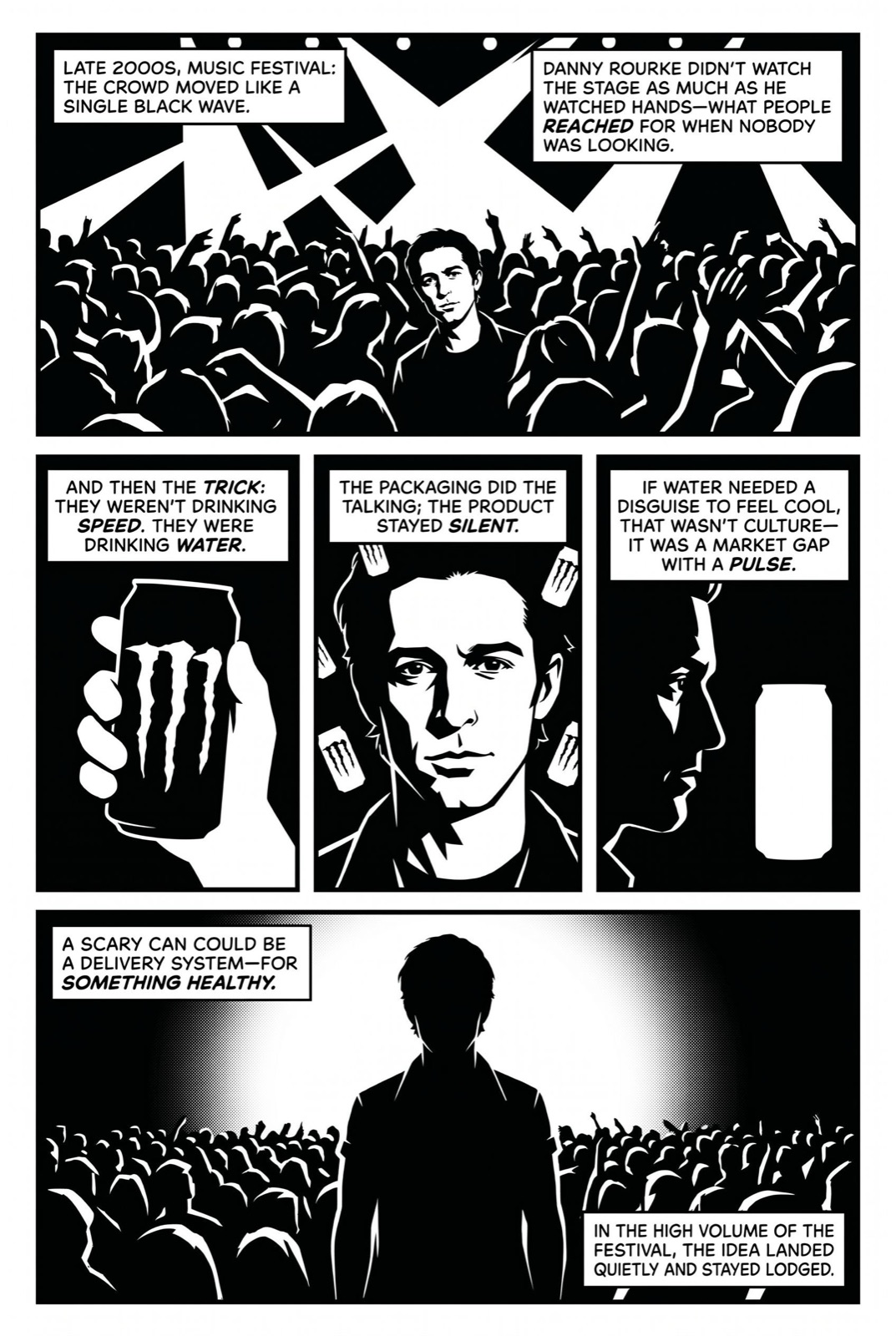
A traveling punk and metal music festival, late 2000s. Danny Rourke is a graphic designer and advertising creative from a small town, and he is watching the crowd instead of the stage. Up near the front, musicians and fans are tipping back cans branded like energy drinks — the kind of loud, aggressive packaging made for soda and caffeine. But Rourke clocks something absurd: a lot of what they're actually drinking out of those cans is plain water. The cans looked cool on stage, so the water hid inside them. That small, ridiculous gap lodges in his head.

Rourke had spent his career inside marketing, watching the same pattern over and over: the funniest, most memorable, most irreverent branding always went to junk food. Healthy products got earnest, boring packaging. He keeps circling one question. In his words: "Why aren't there more healthy products that still have funny, cool, irreverent branding? Because most of the funniest, most memorable, irreverent branding marketing is all for junk food." The thesis writes itself — give water the loud, heavy-metal branding the world reserves for the stuff that's bad for you.

The idea gets a name built to provoke: Reaper Water. Mountain spring water, sold in a tallboy aluminum can dressed like a metal album cover. A tagline engineered to make people laugh and look twice: "Drown Your Thirst." In the late 2010s, the trademark application for Reaper Water is filed. The joke is now a plan. Rourke's framing of the whole mission: "We want to create truly healthy, better-for-you beverages, but just do so in the same funny way that typically unhealthy brands get marketed."

Here's the part that breaks the rules of how you launch a company. Before there's any actual product to sell, Rourke makes a cheap, deliberately outrageous promotional video. Accounts put the production cost at roughly $1,500. It racks up around 3 million views. There is no inventory, no shelf, no can you can buy — just an audience, proving it exists before the business does. That traction is the proof of concept that turns a "dumb idea" into something investable.

The company is formally founded near the end of that year. A few months later, consumer sales begin — real cans of mountain water, stamped with the tagline and the brand's other rallying cry: "#KillPlastic." The aluminum can isn't just packaging; it's the argument. Aluminum is infinitely recyclable where plastic is not, and the brand pledges to donate a share of profits toward fighting plastic pollution. The scary can is secretly the responsible choice.

Rourke runs Reaper Water less like a beverage company and more like an entertainment company. The strategy is "marketing as entertainment" — comedy, stunts, and merch instead of conventional ads, deliberately handing a healthy product the irreverent attitude usually saved for junk food. Even the caffeine philosophy is contrarian. As Rourke put it: "We thought, 'Let's have a sane level of caffeine, that's equal to a cup of coffee, because it seems like the category has gone a little caffeine-crazy.'"

The money follows the audience. A $1.6M seed round (led by a well-known startup studio) in its first year. A $9M Series A early the next year. $23M Series B that fall. $15M Series C the following spring, then a far bigger $75M round at roughly a $525M valuation. Later that year, about $70M more at a $700 million valuation. A couple of years on, around $67M at a $1.4 billion valuation — roughly double the year before. Revenue climbs from about $45 million to roughly $263 million in retail sales over two years. Investors reportedly include big names — a legendary skateboarder, a movie star, and a chart-topping rapper. The last panel is the can — the same scary tallboy spirit from the festival floor — now worth a billion dollars, because someone gave water the branding nobody thought it deserved.