Storyyour input · ~742 words
The Shoe That Refused to Shout
THE UNBRANDED SHOE
How a footballer turned highland wool into Tern

THE ATHLETE
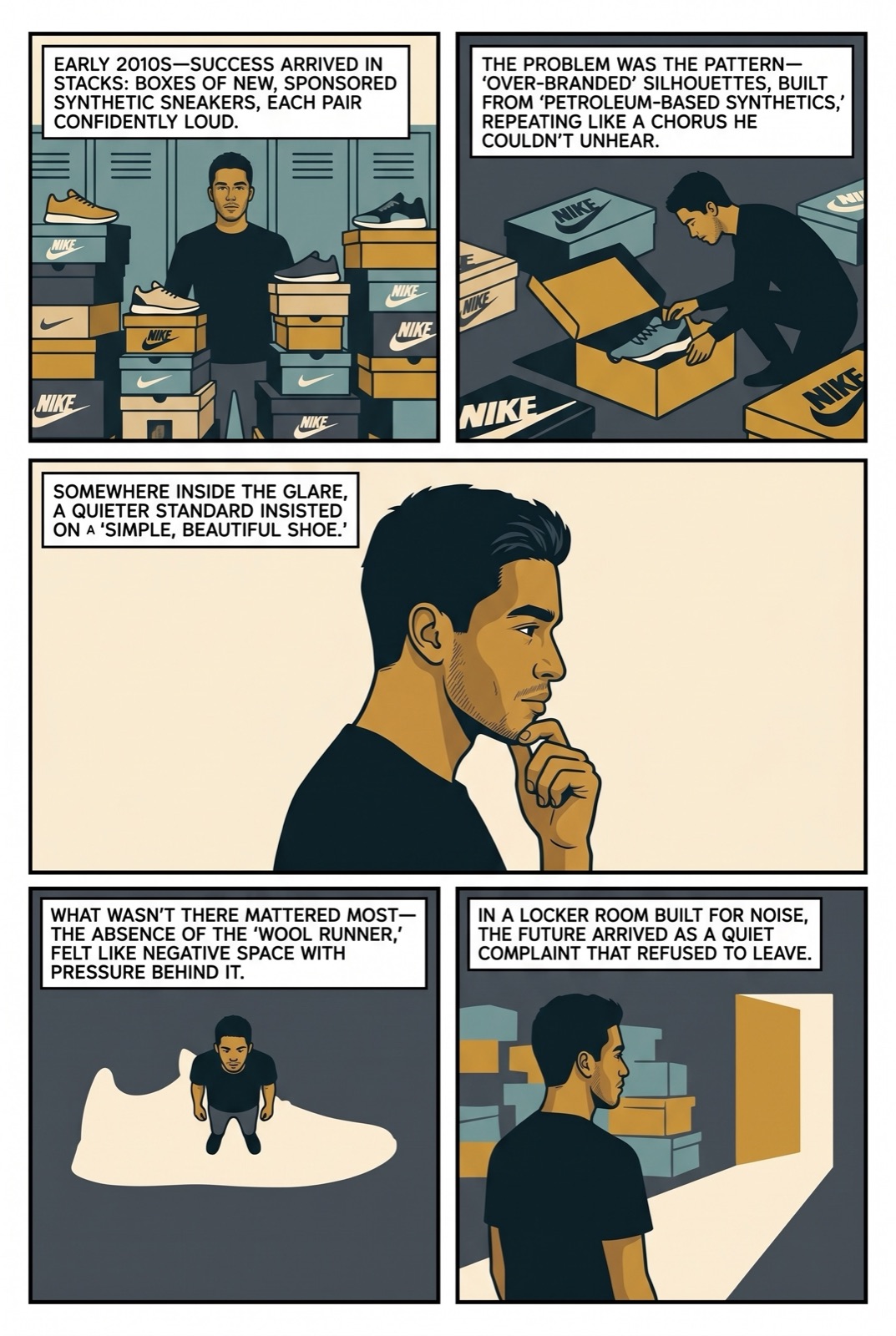
Will Marsh had spent his career inside loud shoes. A national-team footballer from a small, sheep-farming country, he played for the senior side and, in the early 2010s, was named vice-captain in his country's final squad for the sport's biggest international tournament. For years the perk of being a pro was free sneakers from a major sportswear company — boxes of them, every pair stamped with logos. He kept noticing the same thing: they were over-branded, made from petroleum-based synthetics, and somehow it was strangely hard to find a simple, beautiful shoe. The wool runner does not exist yet. The idea of it is already forming.

THE SEED OF AN IDEA
Still playing, Marsh read a magazine article about the struggles of his country's highland merino wool industry. In his words: "I read about the challenges of the wool industry in a magazine back home when I was playing soccer, which kicked off this whole idea." A question lodged itself and would not leave: why was no one making a simple, natural-wool shoe? The sneaker takes shape in his imagination — woolen, quiet, logo-free.

THE PIVOT
The tournament turn was hard. In a friendly that spring, Marsh fractured his upper arm and lost match fitness; he did not appear in his country's tournament-finals matches. He retired from football a couple of years later and enrolled in business school at a top London university to learn how to turn a prototype into a company. Around the mid-2010s, with merino demand falling, he secured a grant from his country's wool industry and engineered a superfine 16-micron merino fabric for footwear. As he later put it: "This was a bad idea for a long time before it was a good one." The prototype shoe sits on a workbench, half-finished, the hero taking form.

PROOF OF CONCEPT
That same year, Marsh put the idea on a crowdfunding platform — and the answer came fast. In just five days, the campaign raised well over US$100,000. Strangers wanted the simple wool shoe he had been chasing. "I had a window of time to sort of take this idea that was very much a prototype and see if it was a business," he said. "If I didn't have that time, I probably wouldn't have [started] it." The sneaker, now real enough to back with money, becomes the thing people are reaching for.

THE PARTNERSHIP
To make the materials genuinely sustainable, Marsh teamed up with Daniel Reyes, a biotechnology engineer and renewables expert who had worked on algae-based fuels. Around the mid-2010s the two became co-founders and co-CEOs, and Tern was founded soon after. Backed by a few million dollars in seed funding, they set out to build a shoe from nature. Two founders, one shoe between them on the table — the hero passing from idea to enterprise.

LAUNCH
The following spring, from a West Coast tech city, they released their first product: the Cloudstep wool runner. The simple, unbranded shoe Marsh had wanted for years was finally on feet. The hero object steps into the world — clean lines, no shouting logos, the antidote to the boxes of branded sneakers he had once been handed for free.

THE MISSION
Tern built its identity around natural and recycled materials: merino wool, tree fiber from eucalyptus, and a sole material made from recycled sugarcane — all aimed at driving the company's carbon footprint toward near zero. It earned a respected sustainability certification and operated as a public benefit corporation. The wool runner stands at the center of a quiet philosophy: make a beautiful shoe, and make it from the earth.

THE SUMMIT
The simple shoe carried the company a long way. A few years after launch, a major growth round valued Tern at well over a billion dollars — unicorn status. (Its earliest backing had been led by a venture firm that bet early.) That autumn, Tern went public on a major stock exchange under its own ticker. Reflecting on what had drawn investors, co-founder Daniel Reyes said: "We did get exposure to a lot more pockets of capital as a result of the fact that people saw the genuine and authentic leadership that we're putting forward on sustainability." The wool runner — the unbranded shoe that began as one footballer's quiet frustration — closes the story exactly where it lives: at the center of every frame.