Storyyour input · ~848 words
Hey, Kid... Catch.
Hey, Kid... Catch: The True Story of the Cola That Became a Legend

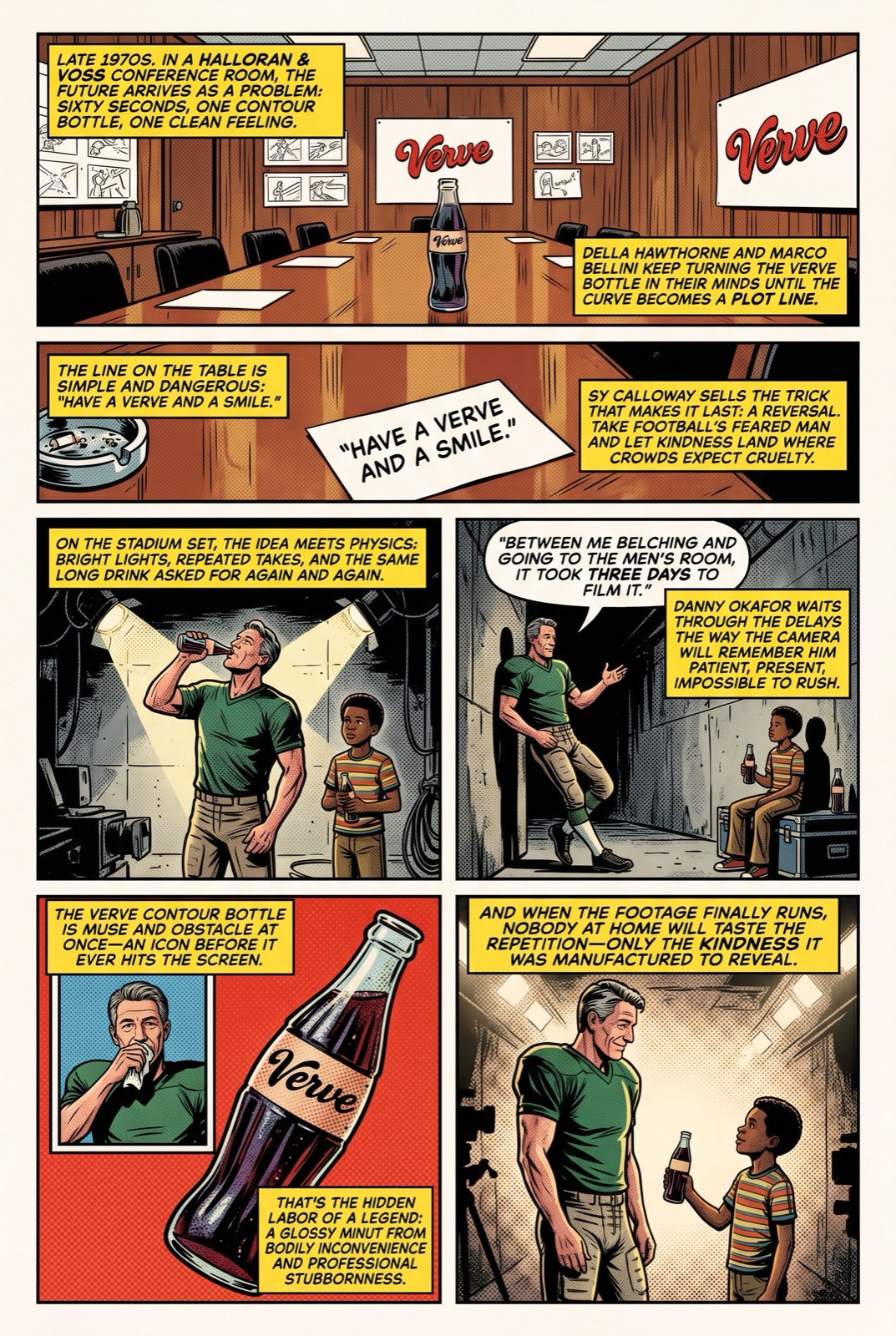
At the Halloran & Voss ad agency in the late 1970s, the assignment was the warmest line in the business: "Have a Verve and a Smile." Writer Della Hawthorne, art director Marco Bellini, and director Sy Calloway needed a sixty-second story that earned that smile — one built around the famous bottle, the curved contour glass with the red Verve script running down its side. What they made would outlive every career it touched.

The idea was a reversal. Take the most feared man in football and let one small kindness crack him open. They cast the man himself: "Mean" Marcus Doyle, the defensive tackle who anchored the Allerton Ironworkers' legendary Iron Wall. The nickname had followed him from his college days with the Bayard State "Mean Cardinals," but the man underneath was the whole point of the ad. Opposite him they cast a nine-year-old child actor named Danny Okafor, whose only job was to hold out a bottle of Verve and mean it.

They shot it in late spring of the late 1970s in a small stadium just outside the city, and it did not go smoothly. The plan was simple; the execution took three grueling days, slowed by technical difficulties — and by the bottle itself. The script called for Doyle to drink the Verve, and he drank it take after take, the contour bottle going up to his lips again and again under the lights. Years later Doyle would put the real reason plainly: "Between me belching and going to the men's room, it took three days to film it."

On screen, the story is this. An injured, limping Marcus Doyle drags himself alone down a concrete stadium tunnel toward the locker room, jersey filthy, shoulders down, every step a small defeat. A boy appears at the edge of the frame and trails after him, clutching a bottle of Verve, the red script bright against the gray of the tunnel. The boy asks if he can help. Doyle, barely turning, waves him off and keeps limping.

The boy doesn't give up. He just walks alongside his hero and tells him, plainly, that he thinks Doyle is the best there ever was. Then he holds out the one thing he has — his bottle of Verve. Doyle stops. He looks down at the kid, and at the cold contour bottle with the red wordmark catching the tunnel light, and something in the hard man gives. He takes it.

He drinks the whole thing. The boy waits, watching, while Doyle tips the bottle back and drains every last drop, the long quiet pull that is the real heart of the ad. The toughest man in the league, undone by a child and a Verve.

Then the turn that made it immortal. The boy, his gift given, turns to leave — and Doyle calls after him: "Hey, kid... catch." He tosses the boy his game jersey, the prize the kid never dared to ask for. The boy's face breaks wide open: "Wow! Thanks, Mean Marcus!" And Marcus Doyle, for once, smiles — the exact smile the whole campaign had been chasing — and turns back toward the locker room. Small gift repaid with a bigger one. A Verve for a jersey. A scowl for a smile.

The spot debuted in the fall of the late 1970s during the network's marquee primetime football broadcast. It won a Beacon Award and was celebrated as one of the best commercials of the year. But its real explosion came when Verve re-aired it during the championship final that January, in front of an enormous audience — the moment a good commercial turned into a national legend.

And then it refused to end. The story Doyle drank on camera kept finding new life: a spinoff TV movie, "The Ironworker and the Kid," aired on a rival network a couple of years later, with a young Eli Brandt in the boy's role. Decades later, for that season's championship final, Verve remade the whole thing for Verve Zero with Ironworkers safety Teva Malosi in Doyle's place. And in the most human postscript of all, Marcus Doyle and Danny Okafor — the mean man and the kid, now grown — reunited in real life decades after the tunnel, proof that sixty seconds about a bottle of Verve and a moment of kindness had outlived the careers it borrowed.

Doyle's own career needed no commercial to be remembered: he played for the Ironworkers across thirteen seasons, won four league championships, was twice named the league's Defensive Player of the Year, and was inducted into the sport's Hall of Fame a few years after he retired. But ask almost anyone who lived through it, and the first thing they'll picture isn't a sack or a championship. It's a tired giant in a gray tunnel, a small boy, and a contour glass bottle with a red script name — held out, accepted, and emptied — that turned a scowl into a smile the whole world remembered.