Storyyour input · ~797 words
The Cooler That Would Not Quit
SUMMIT — Built to Be Overbuilt
A true story of two backcountry brothers, one stubborn cooler, and a bet everyone called crazy.

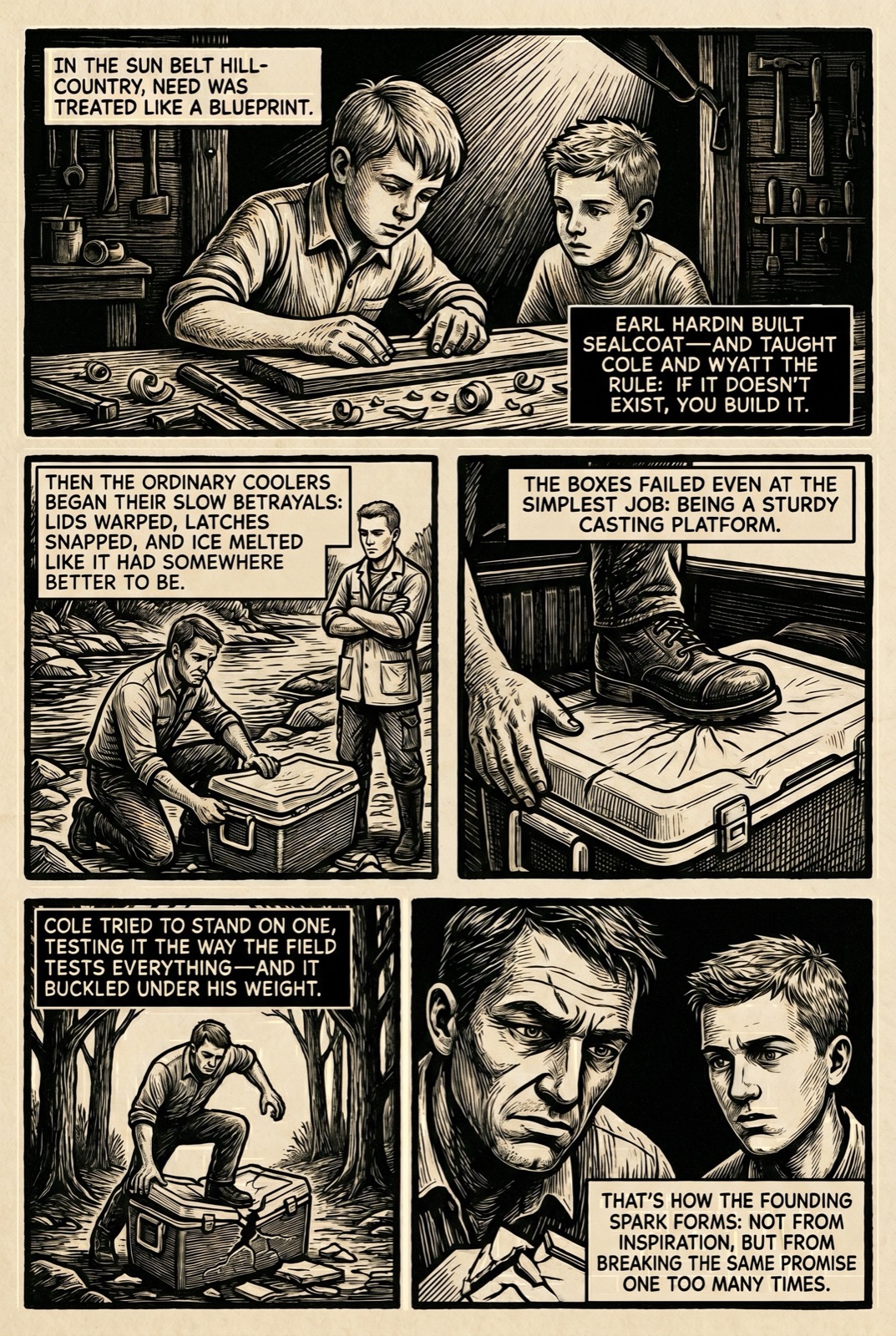
Cole and Wyatt Hardin grew up in the hill country of the Sun Belt, in a family that made things for a living. Their father, Earl Hardin, was an entrepreneur — he had built a company called SealCoat around a fishing-rod epoxy. The brothers absorbed the maker's instinct early: if a thing was broken, you didn't complain about it, you fixed it. And if the thing you needed didn't exist, you built it.

The two brothers grew into serious outdoorsmen. Cole built custom fishing boats. Wyatt ran his own fishing-rod business, Riverbend Rods. Their lives were spent on the water and in the field, where gear isn't a hobby — it's the difference between a good day and a wasted one.

There was one piece of gear that betrayed them again and again: the cooler. Ordinary coolers couldn't survive the way the brothers actually used them. Lids warped. Latches snapped. Ice melted fast under the brutal Sun Belt heat. The boxes couldn't even take a man standing on them to scan the water — a cooler doubled as a casting platform, and the cheap ones buckled. That endless, low-grade frustration became the founding spark.

Instead of buying another cooler that would fail, they decided to build the one that should already exist. In the mid-2000s, in their hill-country hometown, Cole and Wyatt Hardin founded SUMMIT. Their answer was the Ridgeline: rotomolded — formed by the same rotational-molding process used to make whitewater kayaks — with thick, foam-insulated walls. It was deliberately overbuilt: designed to survive abuse and to hold ice for days, not hours.

Then came the move everyone said was crazy. They designed the cooler first and let the cost set the price — and that price landed at roughly $250 to $300. That was about ten times the cost of a typical Frostway or Camprite. Cole Hardin has called it the "10X" premium. Selling a cooler for ten times the going rate sounded absurd. The brothers were betting that a small number of people would pay for something that simply would not quit.

SUMMIT couldn't afford mass advertising, so it didn't chase millions of strangers. It went to the people serious outdoorsmen already trusted. The brothers handed coolers to respected professionals — hunters and anglers like Dale Brackett and Marty Cordova — and let the gear speak. As Cole Hardin put it: "If you're a game hunter in the high country, you're going to know Dale Brackett. If you're a serious saltwater fisherman, you're going to know Marty Cordova. Both of them have given video testimonials on our site. We approached them even though we didn't have the resources to sponsor those guys at the time. We'd give them our cooler; they'd use it and give us a testimonial." At the time, Cole noted, no other cooler company was advertising to outdoor enthusiasts or taking advantage of the professionals in the sport.

Word of mouth did the rest. The company educated its buyers on exactly why the cooler cost what it did — so an owner could stand behind it. "I really felt like we educated our consumer on the selling points of our product," Cole Hardin said. "So when someone had a Summit cooler in the back of their truck, they could defend that." Those small, targeted campaigns weren't built for reach. As SUMMIT marketing VP Dana Whitlock described it: "Those commercials didn't reach millions of people, but the people that they did reach were the most serious hunters and fishermen." And the overbuilding wasn't just talk — the Ridgeline line earned bear-resistant certification from the National Wildlife Safety Council, qualifying for use in bear country when locked with two padlocks. The cooler was tough enough to stand between a hungry bear and your food.

The bet paid off, and then some. Sales climbed into the low hundreds of millions within a few years — and then more than tripled the year after, throwing off tens of millions in earnings. The overbuilt cooler nobody thought would sell had become a phenomenon, the kind of object people put on a pedestal as much as in a truck bed.

A few years later, SUMMIT went public on the national stock exchange under the ticker SMMT, selling millions of shares to eager investors. The brand kept climbing — within a decade it reported well over a billion in revenue and well into nine figures of net income, with a lineup that now spans coolers, vacuum-insulated stainless drinkware, soft coolers, dry bags and more. It started with two backcountry brothers who got tired of their cooler breaking — and decided to overbuild the one that wouldn't.