Storyyour input · ~699 words
The Suitcase That Refused to Break
THE REPLACEMENT NOBODY COULD FIND
A true story of Voyager — a metro city in India

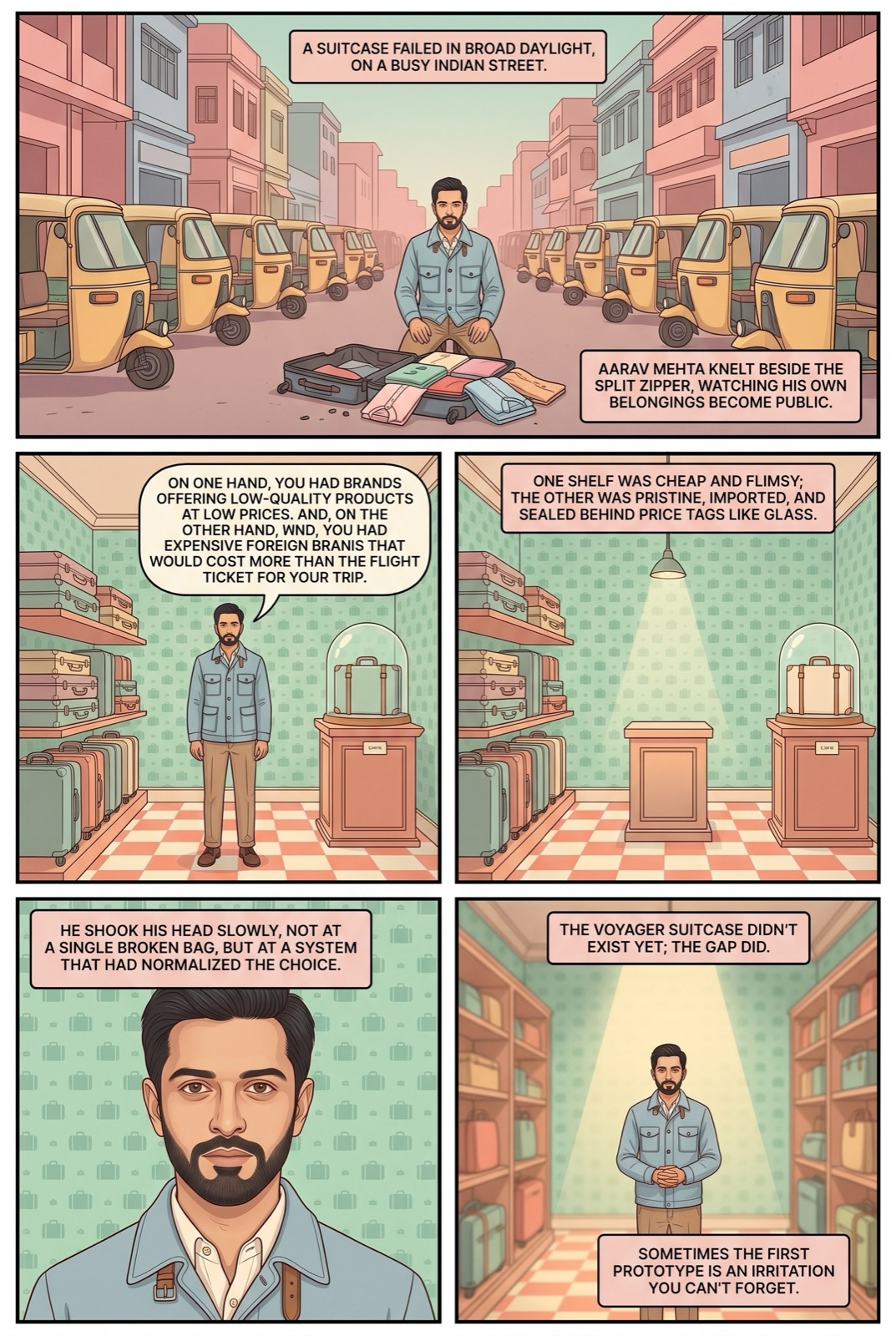
Somewhere mid-trip, a suitcase gives out. The man carrying it is Aarav Mehta, and the failure sends him shopping for a replacement he assumes will be simple to find. It isn't. He works his way through option after option and keeps landing on the same two extremes. As he later put it: "On one hand, you had brands offering low-quality products at low prices. And, on the other hand, you had expensive foreign brands that would cost more than the flight ticket for your trip." Cheap and flimsy, or imported and absurd. Nothing well-designed sits in the middle. The empty space between those two shelves is where the whole idea begins.

Rewind to Homecraft, the furniture e-commerce company where Aarav Mehta — an operator who had also passed through a giant online marketplace — crossed paths with Kabir Saxena, who came from a brand-strategy background. Different lanes, same building. But both had watched, up close, what happens when real design thinking finally walks into a category that never had any. A broken bag would eventually give them a category of their own.

Around the start of the decade, they commit. There is no fat market study, no spreadsheet promising a fortune. "We didn't know how big the market was," Mehta said. "It was just junoon. If we had looked at too much data, we wouldn't have built this." Junoon — obsession. The pandemic, instead of stopping them, becomes useful cover. As Saxena framed it: "Good things take time, and the pandemic helped us drown out the noise and double down on product design." Two founders, one stubborn conviction, and a sketch of a bag that does not exist yet.

Then comes the part nobody sees on a shelf. Roughly eighteen months of field testing: zip-pulls yanked until they fail or refuse to, suitcases dropped down flights of stairs, bags hauled through flights and ferries to see what actually breaks. The founders tour more than fifty contract factories overseas and lock in manufacturers who also build for premium names like Aldermont and Voltura. The very first prototype is designed at a European studio and made overseas. Their rule for all of it, in Mehta's words: "Design isn't just aesthetics. It's how it behaves, how it ages, how proud you feel using it." And just as firmly: "Knowing what you don't want to build is just as important as knowing what you do."

Investors do not see it. A premium Indian luggage brand sounds, to most, like a boring bet in a boring category. Voyager is rejected thirty-three times before the first checks arrive. When belief finally lands, it lands hard: an early Series A of about six and a half million dollars led by Northwind Capital and Tideline Ventures, with angels including Rohan Khanna of a celebrated skincare label, Aarav's old Homecraft chief Vivaan Desai, Ishaan Kapoor of a home-interiors startup — and film star Tara Rao. The bag nobody would fund is suddenly the bag worth backing.

That same year, one product goes live online — a single Cabin Luggage, the lone object the entire company is staked on. The founders' method holds steady. As Mehta described it: "We've designed products for ourselves, our friends and loved ones, and when we feel like it's good enough for them, we back the designs with data." That first cabin bag does not stay alone for long. The range grows — backpacks, briefcases, totes, handbags, travel accessories, even kids' products — all trailing back to one suitcase that started rolling.

The "boring" category turns into a growth story. Revenue climbs from about fifty crore one year to roughly a hundred and seventeen crore the next — more than double — while the company stays profitable. A year or so after launch, Voyager partners with the airline SkyHopper to launch a co-branded "Voy-SH" luggage range. Soon after, it raises about twelve million dollars, led by Crestmont Growth Partners alongside existing investors. The replacement one traveler couldn't find on any shelf in India has become the brand thousands now travel with — the same cabin trolley, rolling on.