Storyyour input · ~982 words
A Bird That Climbs on Wind
Before Lark was a company, it was a frustration.

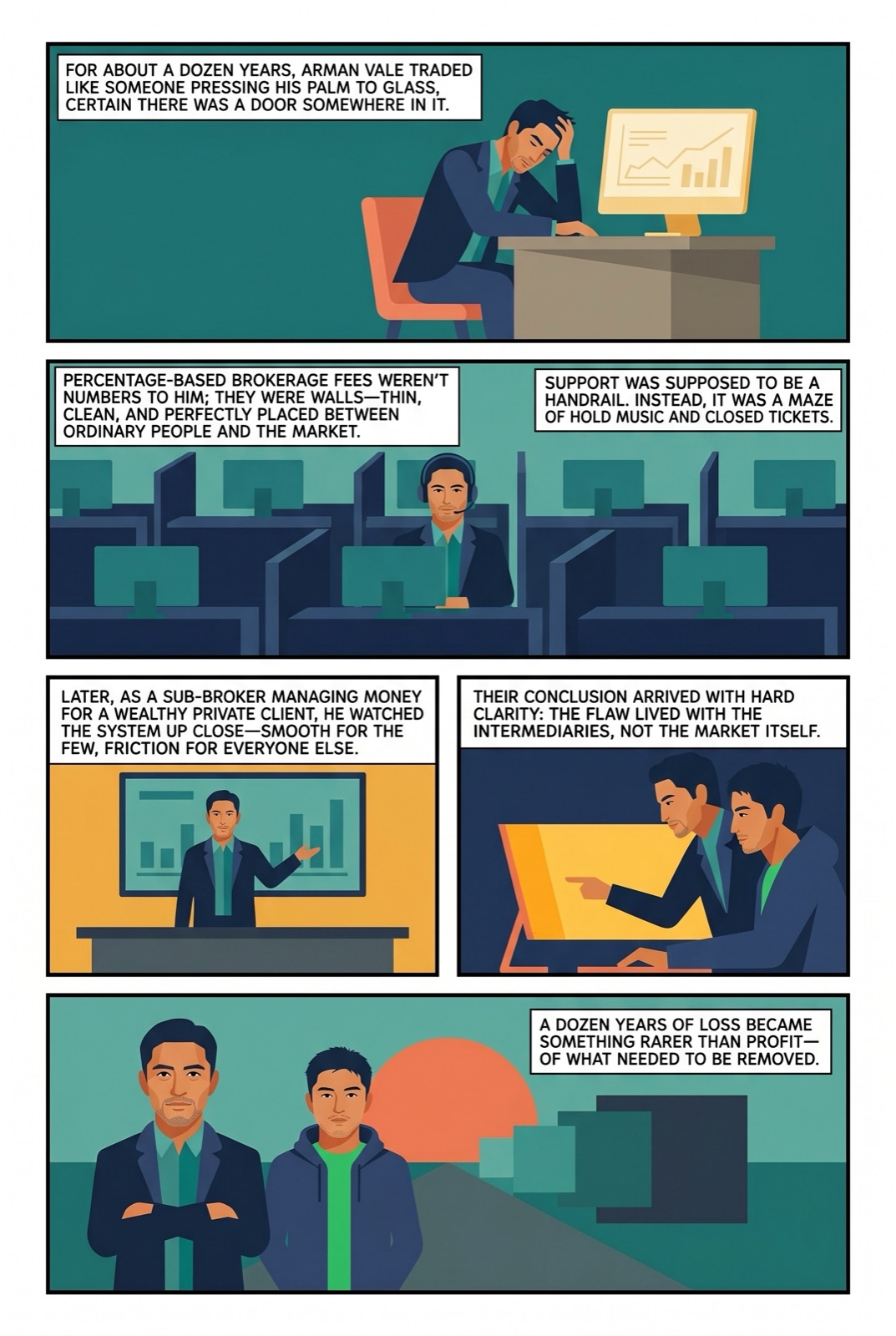
Arman Vale started trading his country's markets as a teenager, around the age of seventeen. By his own account he traded for about a dozen years before founding Lark — and along the way he kept running into the same hurdles and lost money. Trading was walled off: high, percentage-based brokerage fees, weak technology, and poor support stood between an ordinary person and the market.

Arman learned the business from the inside. To keep trading, he worked through his early years on the markets, even taking a night job at a call centre while he traded by day; he later became a sub-broker and managed money for a wealthy private client — close enough to the machinery to see exactly where the walls were built. His younger brother Devin, also a self-taught trader, came in beside him as co-founder.

The lesson of that stretch was simple and expensive: the problem wasn't the market. The problem was everything standing in front of it.

So the brothers decided the problem they had lived would become the product they built: a broker designed to remove the barriers, not profit from them.

They gave it a name that was also a mission statement.

"We named the company Lark, for the bird that climbs straight up on nothing but the wind — free, unburdened, no barrier in front of it." — Arman Vale, Lark

Free flight, no barrier. As Arman has put it: "Lark is the bird that needs no runway. Removing all barriers for traders — that's what we were trying to attempt when we started." The name itself was the promise — to break down what traders and investors face in terms of cost, support, and technology. (A small graphic on the page can show a flat horizon line lifting into a wing — and the Lark logo resolving out of it.)

There's a date that fits the idea perfectly.

"We kick-started operations on our national day, in the early 2010s." — Lark

A day the whole country celebrated freedom. From a single inland tech city, Lark opened its doors with a model that was radical for the country at the time: a flat fee per executed trade instead of a percentage of the trade's value — and zero brokerage on long-term equity investing. Trade a thousand or a million, the brokerage on an executed order stayed the same, capped low. On delivery investing, it was free.

Lark had set out to pioneer discount broking in its market. The Lark logo — the small upward bird, like a kite catching wind — became the mark on the door.

Here's the part most startups can't copy.

Lark raised no venture capital. None. It was fully bootstrapped, founded by the Vale brothers and grown entirely from its own operating profits. And it spent essentially nothing on advertising. That wasn't only a constraint; it became a stance.

"The reason we could bootstrap was that we never spent on ads. With no ads, a business is forced to constantly think & do things to get customer love and organic growth." — Arman Vale

They tried paid ads exactly once. As Arman describes it: "The only time we experimented with ads was for our own brand name — show our website if you search for us. We stopped immediately when we realized that it made no difference to the traffic and the ad was essentially cannibalizing our organic traffic while costing us money." Referrals and word of mouth became the engine. Customer love, he has said, is "a real superpower for us."

So instead of buying attention, Lark built things worth talking about: the Glide trading platform, Nest for mutual funds, Ledger for reporting, and Schoolhouse — free investor education for anyone who wanted to learn. The product did the marketing. (The Glide app mark recurs here, opening on a customer's screen.)

Word of mouth, it turns out, compounds.

"We are now the 3rd largest stock broker in the country in terms of active clients. Thank you for helping us achieve this in just under 8 years." — Lark

Under eight years in, no ad budget, no outside money — third largest in the country. Then it kept climbing. A year later, Lark became the country's largest retail stockbroker by active client base, overtaking Meridian Securities, the bank-backed broker that had held the top spot for roughly a decade.

Then came the milestone that usually requires a fundraise: Lark crossed a one-billion-dollar valuation and became a unicorn — reached not through a venture round, but through an employee share buyback for its own people. The customer base went from about 1.3 million in early one year to nearly 10 million by the end of two years later. (On this page, the Lark logo can scale up across a rising chart of active clients.)

A broker named after free, unburdened flight had become one of the most profitable companies in the country.

For its most recent full year, reported revenue was about one billion dollars with net income near half a billion — and in earlier years too the profits were striking for a firm with no investors to repay. On its national-day anniversary, fifteen years on, Lark marked the milestone still fully privately held. As the company put it: "We have zero debt on the books."

Beyond the core broker, it had grown into an ecosystem: Glide to trade, Nest to invest in funds, Ledger to track it all, Schoolhouse to learn — plus Updraft, the early-stage fintech fund Lark started a few years in that backed a roster of young companies.

No venture capital. No advertising. No debt. Just a flat fee, free delivery trades, and a name that meant exactly what it did: free flight, no barriers.

The last panel: the Lark logo, alone, the upward bird still climbing.